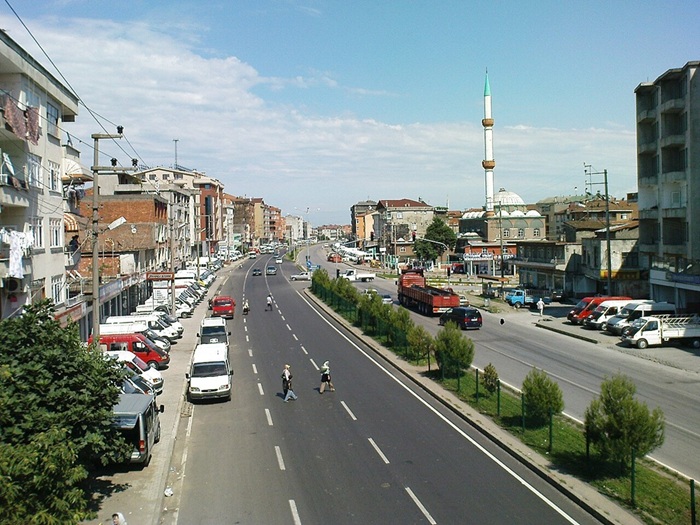
 Terme, Samsun, Türkiye. A view from the overpass. Source
Sam Topalidis (2026)
(Pontic Historian and Ethnologist)
Introduction
Terme (ancient Themiskyra) is located 3-5 km from the Turkish Black Sea coast on the Terme (ancient Thermodon) River (Fig. 1; Plate 1), 60 km (by road) east of Samsun. Terme was probably a Greek colony with an unknown foundation date. Although modest in size, Terme was the seaport on the largest coastal plain in Pontos (in north-east Antolia near the Black Sea), which extended for about 80 km along the shore and 40 km inland (Fig. 1). Historically, the plain produced cereal grains (Roller 2020:22).
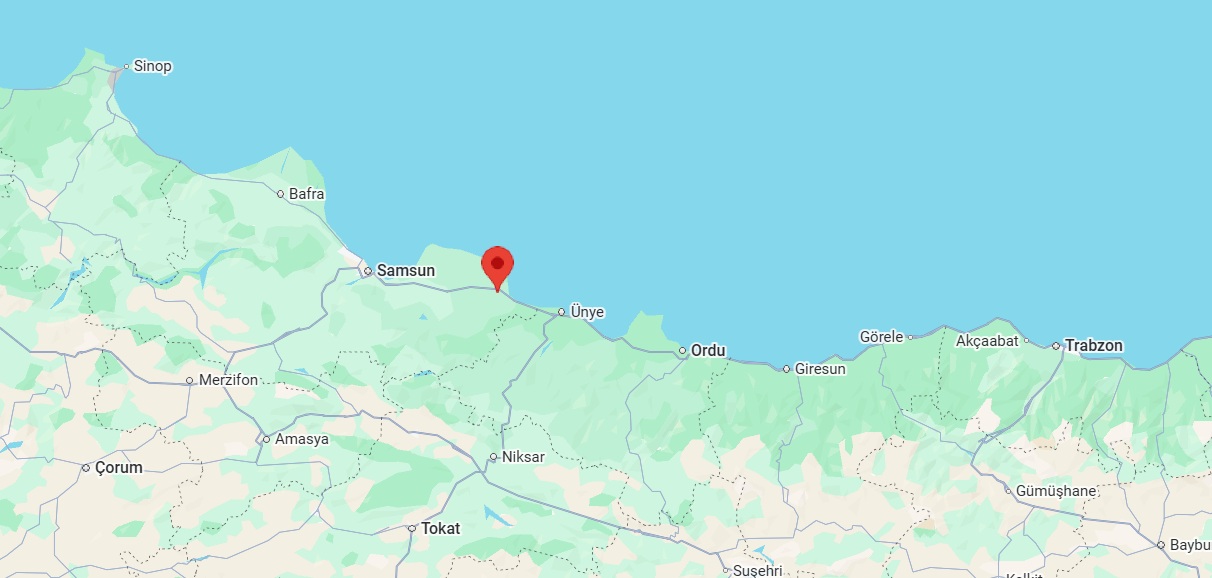
Fig. 1 Terme northern Türkiye (Terme to Unye = 27 km; www.google.com/maps/)
History
At 36 km east of the Terme, a settlement has been dated to the Middle and Upper Palaeolithic periods (40,000–12/10,000 BC). It is the only settlement from the Palaeolithic period on the north-east coast of Türkiye (Oy (2018); Yiğitpaşa and Yağci (2024)).
Apollonius of Rhodes describes the mythical warlike Amazon female warriors who lived around the mouth of the Thermodon River at Themiskyra (Note 1).
The army of Alexander the Great (Macedonian king, reign 336–323 BC) defeated the Persians in Anatolia. In c.302 BC, Mithradates, of Persian descent, established the kingdom of Pontos. Mithradates and kings from the same family ruled over the area from Heraclea (west of Sinope) east to Trabzon on the Black Sea coast until the reign of Mithradates VI who was defeated by the Romans in 64 BC. Themiskyra was taken by the Roman General Lucullus in 72 BC (Source) The kingdom of Mithradates VI was absorbed into the Roman empire in the 60s AD (Erciyas (2001); Roller (2020)). In the 4th century, Anatolia became part of the Eastern Roman (Byzantine) empire.
In 1204 (after the Latins of the 4th Crusade occupied Constantinople), Pontos was ruled by Alexios and David Komnenos at the foundation of the small independent Byzantine Komnenos kingdom of Trebizond (1204–1461) along the northern Anatolian coast (Note 2). In 1347, Unye was lost to the Turkmen emir. Unye [and Terme]1 may have then passed into Ottoman Turk hands between 1404 and 1445 (Bryer and Winfield 1985:101).

Plate 1: Terme, northern Türkiye (Source)
Themiskyra was a delta port and provided harbour for the ships of ancient and medieval times. The fate of Themiskyra is unknown, it may have been overcome by the flow of silt until modern methods of agriculture changed the deltas into a prosperous plain (Bryer and Winfield (1985:8).
In 1836, Terme consisted of a few wooden houses, a mosque and a small bazar. Vessels came up to the town for grain and rice, which they carried along the coast (Hamilton 1842:282). By 1905, Terme’s county population was 19,380 (or 88%) Muslims [probably too high], 2,180 Armenian and 528 Greeks (Source). In 1911, the town of Terme had 277 Greek inhabitants whose main language was Turkish [not Romeyka Greek2 like most Greeks in Pontos] (Kitromilides and Alexandris 1984–1985:36). In 1914, some 100 Armenians also lived in Terme (Kévorkian 2011:492).
Genocide
In July 1915, Armenians from nearby Unye suffered genocide [which spread to Terme] (Source).
In 1916, during World War I, Terme was bombed by Russian ships, however, it was not occupied by the Russians unlike eastern Pontos. Then on 2 November 1916, the Russians landed 40 men with 140 volunteers at the mouth of the Terme River to destroy 20 Turkish barges and sailing craft (Halpern 1994).
After the Russians invaded north-eastern Anatolia in 1916, the Ottoman Turks responded by forcibly moving Pontic Greeks around the Anatolian Black Sea coast into the interior. Without adequate provisions or shelter, many perished (Source).
In April 1917, Couzinos visited Terme and noted, ‘the place is full of swamps, mosquitoes and malaria’ (Couzinos 1969:66). Some Greeks survived (or evaded) the death marches forced upon Terme in 1917 and 1921. According to British Lieutenant Perry’s report of July 1919, of the 835 Greeks and 75 Armenians who lived in Terme until 1919, none remained. All the Greek property had been destroyed (Fotiadis 2019:310).
In early June 1921, (during the Greco-Turkish War (1919–1922) in western Anatolia) a Greek warship bombed Inebolu (west of Sinope) on the Black Sea coast after which Pontic Greek males aged between 15 and 50 years who lived further east on the Black Sea coast were deported to the interior (Mango 2002). In September 1921 the bands of Mustafa Kemal massacred most of the Christian males of Unye (Central Council of Pontus 1922).
In September 1922, after the Turks had recaptured Smyrna on the west coast of Anatolia from the mainland Greek forces, Anatolian Greeks were forced to leave for Greece.3 As a result of the Lausanne Convention, signed by Greece and Turkey in January 1923, those Christian Greeks who had not already left Turkey were forced to leave.
Terme Today
In 2026, Terme’s population was 30,990 (Source). There are many hazelnut and rice factories in the district. The world’s second largest Poplar Forest is in Terme with a timber industry with furnishing workshops. Economic activities in the district include fishing, stockbreeding and beekeeping (Source).
Notes
Note 1
The tale of Jason and the Argonauts and the golden fleece had been told before it was recorded by Apollonius in the 3rd century BC. According to Apollonius, the Amazons lived in three separate tribes. The tribe on the beach were Themiscyreans. The Lycastians lived apart and so did the Chadesians, who were also javelin-throwers. The Argonauts ran ashore at the mouth of the Thermodon. The oldest depiction of a warrior fighting an Amazon is on a terracotta votive shield from 700 BC (Cartwright 2019).
Note 2
In 1214, the Seljuk Turks occupied Sinope. As a consequence, the Komnenoi empire of Trebizond was reduced to a narrow strip of land to the east of the Thermodon River near Terme (Miller 1926).
Acknowledgements
I wish to thank Michael Bennett and Russell McCaskie for their comments to an earlier draft.
References
1. Words within square brackets ‘[ ]’ within a reference are the author’s words.
2. See: www.pontosworld.com/index.php/history/sam-topalidis/892-romeyka-an-endangered-greek-dialect
3. See ‘Family history of Sophie Kiriakidis’ (Topalidis 2024:346–349).
Sources
Alexandris A (1999) ‘The Greek census of Anatolia and Thrace (1910–1912): a contribution to Ottoman historical demography’ in Gondicas D and Issawi C (eds) (1999):45–76 Ottoman Greeks in the age of nationalism: politics, economy, and society in the nineteenth century, The Darwin Press Inc, New Jersey, USA.
Apollonius of Rhodes Jason and the golden fleece, (translated from ancient Greek by Rieu EV), Penguin Epics, 2006, London, England.
Bryer A and Winfield D (1985) The Byzantine monuments and topography of the Pontos, I, Dumbarton Oaks Research Library & Collection, Harvard University, Washington DC, USA.
Cartwright M (2019) ‘Amazon women’, World History Encyclopedia at: www.worldhistory.org/amazon/
Central Council of Pontus (1922) Black book: the tragedy of Pontus 1914–1922, Central Council of Pontus, Athens, Greece.
Couzinos EN (1969) Twenty – three years in Asia Minor (1899–1922), (reprinted in 2010) The Pontian Society of Chicago, Chicago.
Erciyas DBA (2001) ‘Studies in the archaeology of Hellenistic Pontus: the settlements, monuments, and coinage of Mithradates VI and his predecessors’, PhD thesis, University of Cincinnati, Ohio, USA.
Fotiadis KE (2019) The genocide of the Pontian Greeks, (unknown translator from Greek into English), KE Fotiadis, (unknown place of publication).
Halpern PG (1994) A navy history of World War 1, Naval Institute Press, Annapolis, Maryland, USA.
Hamilton WJ (1842) Researches in Asia Minor Pontus and Armenia: with some account of their antiquities and geology, 1, John Murray, London, England.
Kévorkian R (2011) The Armenian genocide: a complete history, IB Taurus, London, England.
Kitromilides PM and Alexandris A (1984–1985) ‘Ethnic survival, nationalism and forced migration: the historical demography of the Greek community of Asia Minor at the close of the Ottoman era’, Theltio Kentrou Mikrasiatikon Spoudon, [Bulletin Centre for Asia Minor Studies], Athens, 5:9–44.
Mango A (2002) Atatürk: The biography of the founder of modern Turkey, The Overlook Press, New York, USA.
Miller W (1926) Trebizond: the last Greek empire, (Society for Promoting Christian Knowledge, London), reprinted 1968, Adolf M Hakkert, Amsterdam, Netherlands.
Oy H (2018) ‘The prehistoric settlement at Tozkoparan (Unye-Ordu-Turkey)’, Karadeniz Araştirmalari Merkezi, 57:33–42.
Roller DW (2020) Empire of the Black Sea: the rise and fall of the Mithridatic world, Oxford University Press, New York, USA.
Yiğitpaşa D and Yağci A (2024) ‘Life activities in the region in the Neolithic, Chalcolithic, and Bronze Ages in the light of the stone tools found in the Ordu and Sinop Museum’, Journal of Ancient History and Archaeology, 11(1):41–57.